
Boards keep asking the wrong question.
Not: “Do we have an AI strategy?”
But: “Which operational constraints will AI move—by how much, by when—and under what accountability?”
That distinction matters because what many manufacturers currently label an “AI strategy” is usually something far safer and far more superficial: a vendor’s roadmap, a growing pile of disconnected pilots, a corporate automation program tucked into HR, Finance, or Legal, or a procurement contest to secure the latest large language model. None of these is a strategy. They are activities. And boards do not fund activity. Boards fund measurable returns.
This is the reality that rarely makes it past PowerPoint: AI does not fail in manufacturing because the models are immature. It fails because intelligence is being layered on top of systems, processes, and governance models that were never designed to learn, scale, or move at industrial speed. When data is fragmented, ownership is ambiguous, and operational decisions cannot be traceably governed, AI simply amplifies existing dysfunction.
And the destination, across industries and regions, is almost always the same:
The Wall of Disappointment: impressive demos, weak industrialisation, and no repeatable operational lift.
This post is a board-level provocation—and a decision tree to fund AI profitably or kill it early.
The Forces Destroying AI ROI in Manufacturing (Right Now)
1) AI gets trapped “upstairs” in corporate functions
AI deployments are too often pushed into HR, Finance, or Legal—not because that’s where the value is, but because it’s where friction is lowest. The factory is harder: legacy systems, safety constraints, OT integration, and real operational risk. So it gets avoided.
The outcome is predictable and corrosive:
- workforce fear replaces trust,
- internal politics slow adoption,
- plant‑level P&L impact remains marginal,
- boards grow impatient, and
- the narrative quietly shifts to “AI equals layoffs,” triggering cultural resistance.
AI didn’t fail here—the deployment strategy did.
2) Business urgency is high. AI literacy is not.
Boards are feeling competitive pressure and are right to demand results. Executives translate that pressure into urgency. But urgency without clarity is not transformation—it’s expensive chaos.
What that looks like in practice:
- vague or fashionable use cases,
- no clearly defined operational constraint,
- no baseline to measure improvement,
- no credible plan to scale beyond a pilot.
This is not a strategy. It is wishful spending with a technology label attached.
3) OT tech debt is still being ignored—or worse, romanticised
If your production environment is running on brittle PLC integrations, undocumented interfaces, vendor‑locked systems, and years of deferred modernisation, AI cannot reliably see the process it is meant to improve. And if it can’t see the process, it cannot win.
A model is not magic. It is an amplifier.
- Disciplined factories become faster, safer, and more profitable.
- Chaotic factories simply produce noise at greater speed.
AI exposes the truth of your operating environment. It does not conceal it.
4) OT still isn’t treated as IT — and that’s a governance failure
If it runs on zeros and ones, it is IT. Yet OT is still too often pushed “to the business,” outside of architectural standards, lifecycle management, identity models, logging, patching discipline, and clear risk ownership.
The consequences are structural:
- shadow IT proliferates,
- the security posture fragments,
- standards quietly collapse, and
- scaling anything—AI included—becomes slow, painful, and risky.
This is not a technology problem. It is a governance decision with predictable outcomes.
If it’s 0 and 1, it’s IT.
5) Security and Audit are enforcing old rules in a new risk landscape
AI introduces failure modes that most governance models were never built to handle: hallucinations, data leakage, model drift, untraceable decisions, and unclear liability. When controls cannot adapt, the default response becomes “no.”
And when “no” is the default, the business routes around governance. That is how localised risk becomes systemic risk—precisely the opposite of what boards expect from control functions.
6) Strategy and culture are misaligned
Even when pilots succeed, they often die quietly because no one can answer a basic question in one sentence:
Who owns the model in production—by name?
IT? OT? Quality? Engineering? The plant manager?
When ownership is ambiguous, accountability disappears. And without accountability, scaling is impossible—no matter how promising the pilot looked in the demo.
The Competitive Reality Boards Should Stop Underestimating
The most dangerous competitors today—particularly fast‑scaling Asian manufacturers—are not winning because they buy better machines. They are winning because they were built for speed from day one. These organisations are often born digital: processes are standardised by design, data is captured as part of the operation, automation is engineered in rather than bolted on, and modern platforms and ecosystems replace brittle, bespoke stacks. As a result, their iteration cycles are materially faster.
This changes the basis of competition. Incumbents are no longer competing purely on labour cost, scale, or footprint. They are competing on learning speed: how quickly they can detect what is happening, decide what to change, act safely in the operation, and improve again—cycle after cycle.
AI, in that context, is not the strategy. It is a force multiplier for learning speed. But like any multiplier, it only works when there is something solid to multiply. Without disciplined processes, decision‑grade data, and clear operational accountability, AI doesn’t accelerate advantage—it accelerates exposure
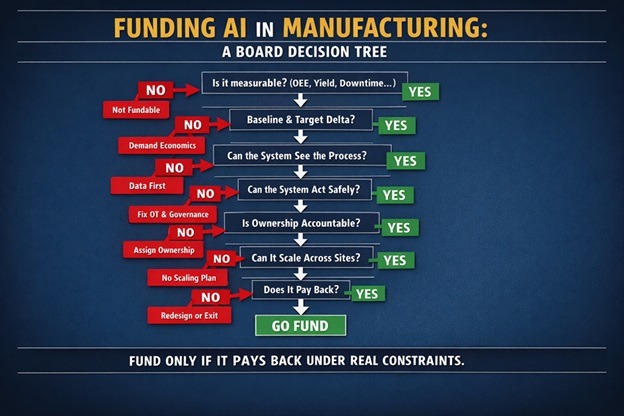
The Board Decision Tree: Fund AI Like a Business, Not Like a Trend
Every AI initiative—whether GenAI, computer vision, predictive maintenance, optimisation, or autonomous agents—should pass through the same decision filter. Not a slide deck. Not a demo. A decision tree that treats AI like a capital allocation choice, not a technology fashion.
Below is the logic in plain board language.
1) Is it measurable?
If the initiative does not move a clearly defined operational constraint, it is not fundable. Full stop.
That constraint must show up in the metrics boards already care about: OEE, downtime, yield, scrap, energy intensity, safety incidents, warranty costs, and inventory turns. If the value cannot be expressed in those terms, it does not belong in an investment conversation.
No measurement means no funding.
2) Is there a baseline, a target delta, and a timebox?
Without a baseline, you cannot prove improvement.
Without a target delta, you cannot judge ambition.
Without a timebox, you cannot manage risk.
An initiative without all three is not an initiative. It is a story—interesting perhaps, but not investable.
3) Can the system see the process reliably?
Data is not “available” because someone can extract a spreadsheet. For AI to work in production, boards should insist on decision‑grade visibility: accurate timestamps, operational context, traceable lineage, quality controls, and repeatable collection.
If the system cannot see the process reliably, AI funding should stop—and be redirected into data foundations. This is not a delay; it is risk control.
4) Can it act safely?
Manufacturing is not social media. Incorrect outputs can stop production lines, generate scrap, introduce safety risks, or create regulatory exposure.
If action boundaries are not explicitly defined—human‑in‑the‑loop controls, safety cases, fallback procedures—then the system is not production‑ready, regardless of model performance.
5) Who owns it in production—by name?
Not “a team.”
Not “a committee.”
A named individual must be accountable for operational outcomes once the model is live. Someone who signs off on performance, risk, and impact.
No owner means guaranteed failure. Accountability is not optional at scale.
6) Can it scale across sites?
A pilot that cannot scale is not a success—it is a prototype. And prototypes are not a strategy.
A fundable pilot must produce reusable assets: an architecture pattern, a data contract, a deployment template, and lifecycle controls (MLOps). If success cannot be repeated across plants, it does not justify continued investment.
7) Does it pay back under real‑world constraints?
This is where most AI programs quietly die. Real costs accumulate fast: OT integration effort, downtime risk, security and audit controls, adoption and change management, vendor lock‑in, and long‑term operating burden.
If the business case only works in a simplified model—and collapses under real operating conditions—the correct board decision is to stop, redesign, or exit.
Funding AI is not about optimism. It is about disciplined allocation under constraint. This decision tree forces that discipline—before money, credibility, and trust are burned.
What Boards Must Stop Funding (Even If Everyone Is Doing It)
Uncorrelated pilots
Proofs of concept that live in isolation—untethered from the target operating model, unclear on governance and ownership, disconnected from scale patterns, production architecture, or business‑unit economics—are not experimentation. They are corporate entertainment. They consume budget, create internal noise, and deliver little more than demo fatigue. Boards should treat these as what they are: cost with no credible path to return.
“Corporate AI first” as the headline strategy
Corporate automation can reduce friction and cost at the margins. But positioned as the centrepiece of an AI strategy, it consistently fails to deliver the operational lift boards expect. Worse, it often erodes workforce trust and reinforces the narrative that AI is about efficiency cuts rather than competitive advantage. That is not a foundation for sustainable transformation.
Waiting for analysts to bless it
A strategy that begins with “we’ll move once the analysts confirm” is not risk‑managed—it is risk‑outsourced. By definition, external validation lags reality. If a board chooses to act only after consensus forms, it has already accepted permanent catch‑up as its competitive posture.
Stopping funding in these areas is not conservative. It is discipline. It is the difference between allocating capital to build an advantage and spending it to feel busy while others pull ahead.
What Boards Should Fund First
The Foundations That Actually Make AI Profitable
1) Treat data strategy as a capital strategy
Boards must stop treating data as an undifferentiated exhaust stream. Not all data is equal, and pretending it is guarantees weak AI outcomes. What boards should mandate instead is clarity: data classification (Restricted, Confidential, Internal, Public), defined data domains with explicit ownership, enforceable quality and lineage standards, and a clear Bronze/Silver/Gold discipline—where “Gold” means decision‑grade data products that the business is willing to act on.
If leadership cannot point to its “Gold” data—by domain, owner, and use—then any AI strategy built on top of it is speculation, not investment.
2) One operating model for Cloud and AI
Cloud Centers of Excellence and AI Centers of Excellence cannot operate as parallel tracks. When they do, scale fractures and accountability blurs. Boards should insist on a single operating model that covers scalable platform patterns, security guardrails, cost control, MLOps lifecycle management, audit controls, and deployment standards.
AI is not a side initiative or an innovation lab experiment. It is production engineering. And production engineering demands industrial‑grade platforms, not bespoke solutions.
3) Business–IT partnership with equal accountability
This is where most organisations quietly fail. Funding AI without enforcing accountability alignment guarantees theatre. The model must be explicit: the business owns outcomes, IT enables scalable and secure platforms, OT is governed as IT, and Quality or Engineering owns acceptance criteria and operational control.
If these roles are negotiated differently for every initiative—or left implicit—AI becomes nobody’s problem once it leaves the pilot stage.
4) Portfolio thinking: GenAI is not the whole game
Boards should resist allowing GenAI enthusiasm to crowd out higher‑confidence value pools. In manufacturing, the fastest and most durable returns often come from computer vision at the edge for inspection, safety, and traceability; predictive machine learning for maintenance and scrap reduction; and optimisation for scheduling, throughput, and energy intensity. GenAI copilots add value when knowledge work is genuinely constraining operations—not when data discipline and process clarity are missing.
GenAI layered onto weak foundations does not create insight. It creates expensive storytelling.
5) OT is IT — non‑negotiable
AI only scales when OT environments meet the same governance standards as IT: defined connectivity patterns, coherent security architecture, identity and logging, disciplined patching, lifecycle controls, and sufficient network capability for sensor, vision, and edge workloads.
If OT remains outside governance, AI will scale outside governance too. And that is exactly where operational, safety, and compliance risks accumulate—out of sight until they become board‑level incidents.
Where AI Actually Makes Money in Manufacturing (Board View)
When AI delivers real value in manufacturing, it does so in places boards can measure, govern, and hold teams accountable—not in abstract capability demos. The most consistent sources of ROI are operational, repeatable, and tied directly to P&L performance:
- Reduced downtime and faster diagnosis, where AI shortens mean time to detect and resolve faults, protecting throughput rather than promising hypothetical efficiency.
- Yield and quality early‑warning signals, catching deviations before scrap accumulates and warranty risk escapes the plant.
- Predictive maintenance at scale, not as isolated use cases but as portfolio capabilities across lines, assets, and sites.
- Energy optimisation and throughput constraints, where small percentage gains translate into material cost and capacity advantages.
- Engineering cycle‑time reduction, from requirements and testing through traceability—compressing the time it takes to move from design to stable production.
- Field‑to‑factory feedback loops, using warranty and quality data to close the learning loop and reduce repeat failures at the source.
In all of these areas, AI earns its keep by accelerating decisions under constraint—not by replacing judgment, but by making it faster and more reliable.
The advantage in 2026 is not “having AI.” It is converting AI into repeatable operational lift—under real industrial, safety, and governance constraints—faster than your competitors.
The Board’s Non-Negotiable Questions (Use These in the Next Steering Committee)
- Which constraint are we moving—and what is the baseline?
- What delta are we committing to within 12 months?
- Can the system see the process (trusted data + context + lineage)?
- Can it act safely (human-in-loop, fallback, safety case)?
- Who owns it in production—by name?
- What is the scale plan across sites (templates, contracts, MLOps)?
- What are we refusing to fund (pilots without scale, tools without outcomes)?
If your AI strategy is mostly about tools, pilots, and demos, you don’t have an AI strategy.
You have a procurement plan wearing a transformation costume.
Disclaimer
The opinions expressed herein are my own and are shared in a personal capacity. They do not reflect the views, policies, or strategic positions of my employer, its management, or any associated organisation. This article represents independent analysis informed by professional experience. AI tools (Microsoft Copilot, with cross‑checking using Google Gemini) were used solely as writing assistance; all conclusions, interpretations, and final content are mine.