
Over the years, I’ve come across far too many initiatives that required critical data decisions. What most of them had in common— with very few exceptions—was the absence of a clear data strategy. At the same time, fundamental questions around data location were left partially or incorrectly answered.
A solid preparation for the upcoming data battles needs to do better than that.
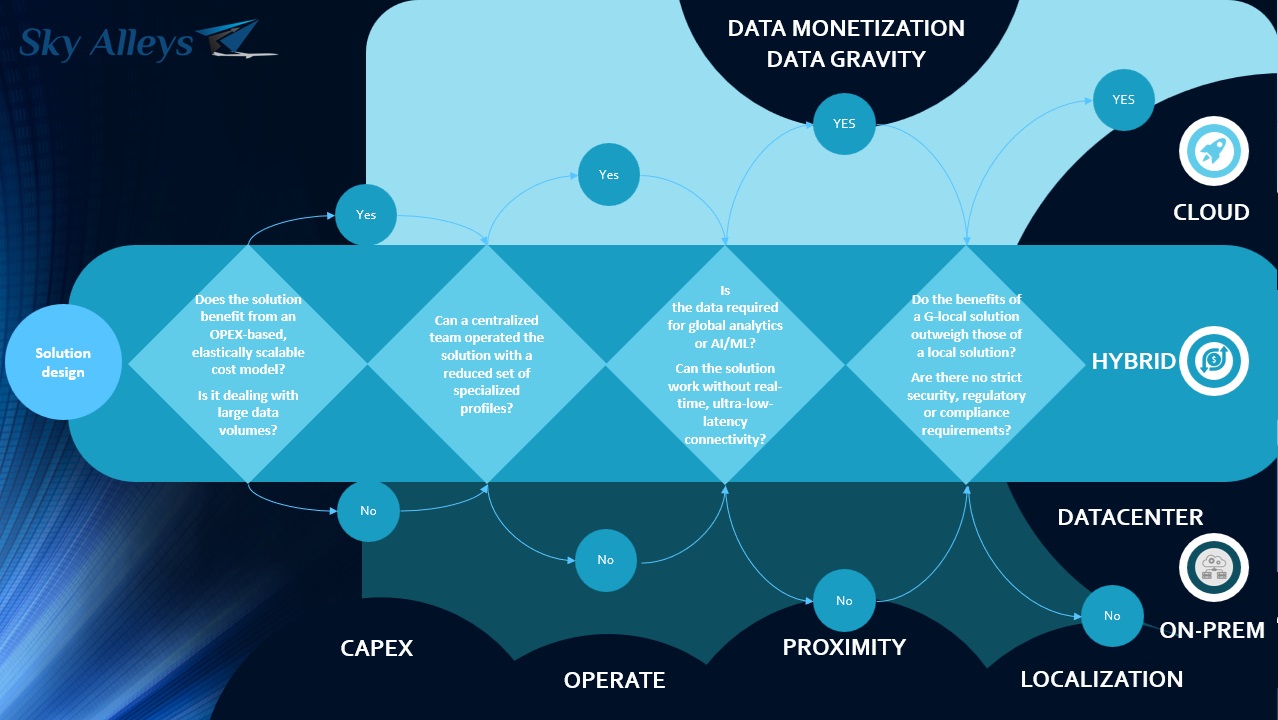
While this post does not aim to replace proper data classification or detailed regulatory and compliance analysis (both are essential), it introduces a pragmatic, self‑developed decision tree for data location. Its purpose is to help organisations frame the right discussions early, as part of their broader technology and data roadmap.
Before diving into the benefits of Big Data platforms or building business cases for emerging AI use cases, I recommend asking the following questions within your organisation as part of the data strategy conversation.
Key Decision Questions
- Does the solution benefit from an OPEX‑based, elastically scalable cost model?
- Is it dealing with large data volumes?
- Can a centralised team operate the solution with a reduced set of specialised profiles?
- Is the data required for global analytics or AI/ML?
- Can the solution operate without real‑time, ultra‑low‑latency connectivity?
- Do the benefits of a G‑local solution outweigh those of a purely local solution?
- Are there strict security, regulatory, or compliance requirements?
How to Think About Each Question
1. Does the solution benefit from an OPEX‑based, elastically scalable cost model?
In most cases, the answer is obvious. Based on the business cases I’ve built in recent years, it is extremely difficult to compete with the unit economics of hyperscalers, particularly for storage, as long as the correct tiering strategy is applied for the specific use case.
2. Is it dealing with large data volumes?
Large data volumes are increasingly impractical and costly to manage on‑premises. Beyond the infrastructure cost itself, data movement, backup, and lifecycle management quickly become limiting factors. And yes—this is also the point where legacy tape systems should already be a thing of the past.
3. Can the solution be operated by a centralised team with a reduced set of specialised profiles?
This question is often overlooked. Cloud platforms enable operational consolidation, automation, and standardisation, which in turn reduce long‑term TCO and accelerate data monetisation.
My advice to CIOs is simple: continuing to invest heavily in legacy on‑premises platforms is risky. In a few years, finding the skills required to operate them will be at least as challenging as justifying the investment itself.
4. Is the data required for global analytics or AI/ML?
Let’s be honest. Unless you are a technology company operating at significant scale, it is unrealistic to replicate—at a reasonable cost—the feature‑rich data and AI platforms provided by hyperscalers.
The real question is not whether you can build it yourself, but whether you want to re‑invent the wheel or focus on solving business problems.
5. Can the solution operate without real‑time, ultra‑low‑latency connectivity?
Real‑time, ultra‑low‑latency workloads are a different category altogether. No matter how much network connectivity has improved over the years, proximity still matters for certain use cases—particularly in industrial, OT, and safety‑critical environments.
6. Do the benefits of a G‑local solution outweigh those of a purely local solution?
This is where a comprehensive business case is essential. In most scenarios I’ve worked on, global platforms outperform local ones. G‑local models, however, often deliver the best balance—combining global scale and governance with local adaptation, personalisation, and regulatory alignment.
7. Are there strict security, regulatory, or compliance requirements?
Security, legal, and regulatory constraints are non‑negotiable, even when they impose physical borders on a digital world that was originally designed without them.
A practical reminder: regulatory discussions should never happen in isolation—data classification is a prerequisite for making defensible and auditable data‑location decisions.
Closing Thought
Data location should not be an afterthought, nor a default reaction to compliance pressure. When approached through a structured decision tree, it becomes a strategic design choice—one that balances economics, scalability, operational efficiency, innovation, and risk.
Hope this helps.
Alex