A sequel to “I Hired Four AI Employees Last Month. They Cost $0 and Never Sleep”
Two months ago, I introduced the Cognitive Work Architecture: an AI operating model where specialized agents function as a virtual workforce, running entirely on Microsoft 365 tools most enterprises already have licensed. No custom code. No Azure OpenAI deployment. Just Copilot Studio, Power Automate, and Dataverse. Lia composes executive briefs and shapes replies, Sara produced 13-point commercial scorecards. Rakaesh delivered technical risk assessments. Mara analyzed Azure Monitor alerts at 3AM while I was asleep. Andre synthesized project status reports in seconds.
Since then, they’ve been promoted. They now assign tasks to each other, share memory across sessions, and run fully automated workflows, including a daily operations digest that lands in my inbox at 10AM sharp, authored entirely by Mara without a single human keystroke.
But here’s what nobody tells you about building AI agents: the ceiling teaches you more than the floor.
The Ceiling I Hit
At 134 alerts, Mara choked. ContextTokenLimitExceeded. Her context window couldn’t hold a full day’s worth of Azure Monitor data in a single pass.
When I tried routing tasks between agents through Power Automate, the connector returned 202 Accepted and dropped the conversation. The task was assigned. The result never came back.
When I reconnected an agent that had been rebuilt, the flow returned: “This action doesn’t support agents built with the GitHub Copilot handler.” Right name. Wrong framework. Silent failure.
I solved each one. Chunked the payload. Rewired the orchestration. Rebuilt the agent in the correct framework. But the lesson wasn’t in the fix.
The lesson was in what these walls revealed about where personal AI ends and enterprise AI begins.
The Insight Most AI Strategies Miss
Every conversation about enterprise AI blurs two fundamentally different competitive advantages into one. Leaders ask “What’s our AI strategy?” as if the answer is singular. It isn’t.
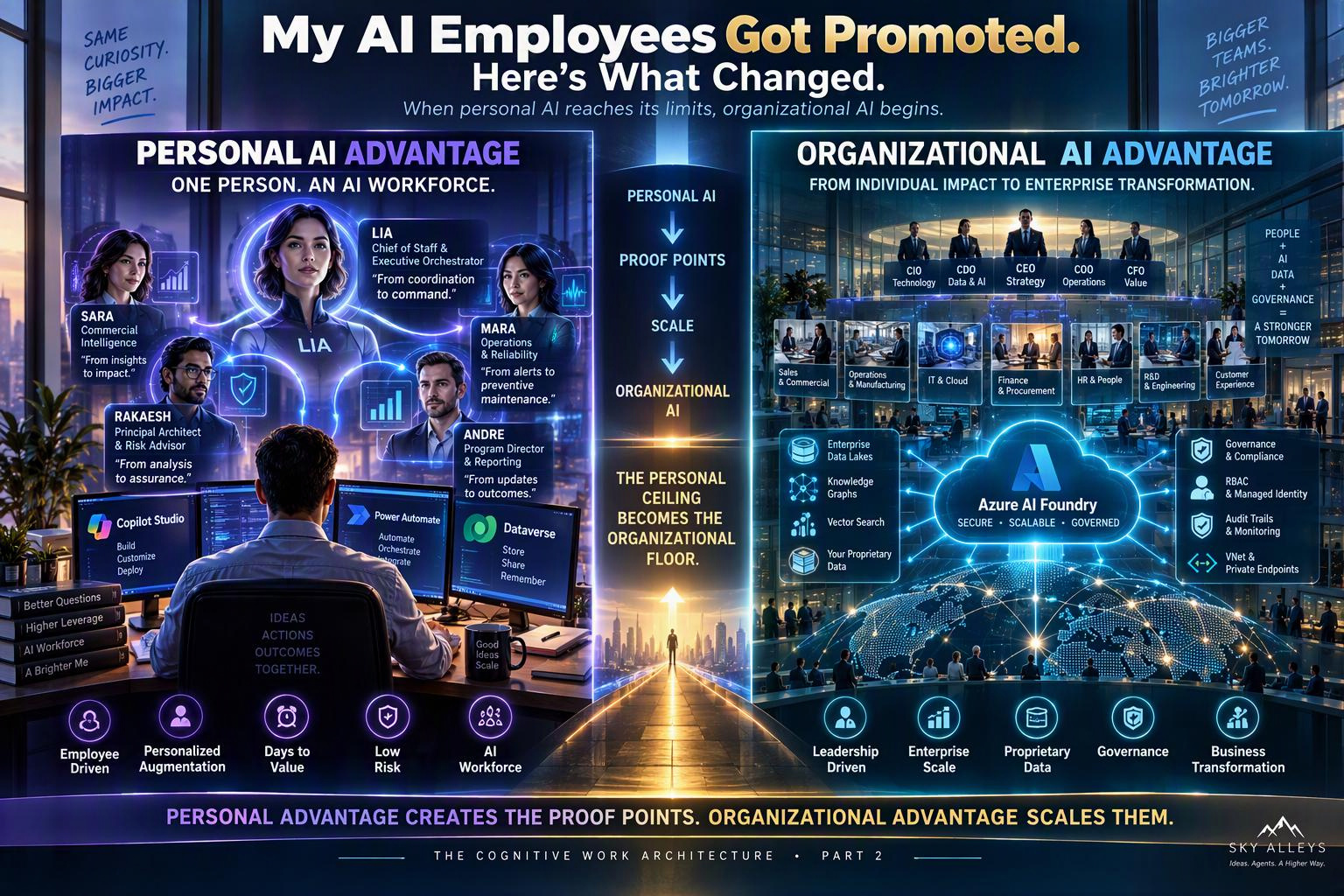
There are two strategies. They require different sponsors, different platforms, different governance, and critically, different success metrics. Conflating them is where most AI roadmaps stall.
Strategy 1: Personal Competitive Advantage
BYOAI: Bring Your Own AI.
This is employee-driven, low-risk, and bottom-up. A knowledge worker picks up a horizontal tool: Copilot Studio, Claude, ChatGPT, and shapes it to their specific work. No IT ticket. No steering committee. No six-month roadmap.
What I built is deeply personal. Sara knows my deal methodology. Rakaesh understands my architecture standards. Mara monitors my infrastructure. These agents are tailored to how I think, what I need, and where my expertise gaps are.
That’s the real promise of the personal AI strategy: not that AI exists, but that AI can be shaped to fit one person’s brain. A citizen developer with domain expertise builds agents that amplify their specific strengths and compensate for their specific weaknesses.
The result isn’t generic productivity. It’s personalized augmentation.
I don’t just work faster. I work with capabilities I didn’t have before: commercial analysis that would take hours, technical due diligence I’d normally delegate, operational monitoring I couldn’t staff. One person, performing like a team.
The characteristics:
- 🧑 Employee-driven: adopted by the individual, not mandated by IT
- 🔓 Low risk: personal scope, tenant-level governance, no customer data exposure
- 🛠️ Horizontal tools: Copilot Studio, ChatGPT, Claude, Gemini, whatever fits the task
- 📈 Metric: individual throughput: hours saved, decisions accelerated, expertise gaps closed
- 💡 No permission needed: any knowledge worker with a license can start today
This is where 90% of AI value is being unlocked right now, not in boardroom strategies, but in individual contributors quietly building their own unfair advantage.
Strategy 2: Organizational Competitive Advantage
This is leadership-driven, top-down, and architectural.
It’s not about one person working faster. It’s about the business operating differently, proprietary data pipelines feeding agentic AI systems, enterprise-grade retrieval across millions of documents, workflow automation that restructures how entire departments function.
This is Azure AI Foundry territory. Not because it’s “better” technology, but because the blast radius demands it.
When your AI serves 500 operations engineers, you need VNet isolation, RBAC, managed identity, and compliance audit trails. When it reasons over three years of incident history instead of yesterday’s alerts, you need hybrid search with vector indexing and semantic re-ranking across millions of records. When it faces customers, you need enterprise operating layers that a personal agent was never designed to carry.
The characteristics:
- 👔 Leadership-driven: sponsored by CTO/CDO/CIO, funded as a platform investment
- 🏗️ Built on proprietary data: your data pipelines, your knowledge graphs, your competitive moat
- 🤖 Agentic AI architecture: multi-step reasoning, tool use, and autonomous decision loops at scale
- 🔒 Strict compliance: VNet, private endpoints, RBAC, sensitivity labels, audit logging
- 📊 Metric: business transformation: revenue impact, operational cost reduction, new capabilities
- 🏢 Org-chart implications: this isn’t a tool. It’s a redesign of how work flows through the organization.
This is where AI moves from “my assistant” to “our operating system.”
The Divergence, Visualized
| Personal Advantage | Organizational Advantage | |
|---|---|---|
| Sponsor | The employee | The C-suite |
| Platform | Copilot Studio, ChatGPT, Claude | Azure AI Foundry, AWS Bedrock, custom ML |
| Data | My files, my context | Enterprise data lakes, proprietary pipelines |
| Governance | Tenant-level, self-managed | Compliance-grade, centrally governed |
| Scale | 1 user, 1 team | Departments, business units, customers |
| Risk | Low, sandbox scope | High, production, regulated, customer-facing |
| Time to value | Days to weeks | Months to quarters |
| Success metric | “I’m 3x faster” | “The business operates 40% leaner” |
| Failure mode | Agent breaks, I fix it | Ungoverned AI creates compliance exposure |
The Harmony Rule
Here’s what the comparison posts won’t tell you: these aren’t competing strategies. They’re sequential.
Personal advantage creates the proof points. Organizational advantage scales them.
My Cognitive Work Architecture started as a personal experiment: one person, five agents, zero budget. It proved that multi-agent orchestration works, that Dataverse can serve as shared memory, that Power Automate can route tasks between specialized AI roles.
That proof point is now the blueprint. The architecture patterns I discovered by hitting walls at the personal level: context limits, async failures, framework incompatibilities, are exactly the design requirements a platform team needs before investing in Foundry.
The citizen developer is the R&D lab. The enterprise platform scales what survives.
And critically, the migration path isn’t a rewrite. Copilot Studio agents can consume Foundry-hosted knowledge bases through custom connectors. You upgrade the grounding layer, not the agent logic. The orchestration survives.
Where It Breaks
Every enterprise I work with makes one of two mistakes:
❌ Mandating organizational strategy before personal adoption exists. A CTO commissions a Foundry platform, hires an AI engineering team, builds retrieval pipelines, and nobody uses them because no one has experienced what AI can do for their work first. The platform is architecturally correct and organizationally dead.
❌ Letting personal adoption grow without an organizational strategy to absorb it. A hundred citizen developers build a hundred agents. No shared data. No governance. No way to turn individual breakthroughs into business capabilities. Shadow AI becomes the new shadow IT.
The skill isn’t choosing one strategy. It’s sequencing both — and knowing when the personal ceiling becomes the organizational floor.
What I’d Tell You If You’re Starting
If you’re a knowledge worker: Start now. Build your own agents. Copilot Studio, ChatGPT, Claude: the tool matters less than the habit. Tailor AI to your brain. Hit the walls. You’ll learn more about what AI actually does from one broken agent than from a hundred LinkedIn posts about what AI could do.
If you’re a technology leader: Don’t start with the platform. Start with the proof points. Find the citizen developers in your organization who are already building personal agents. Study what they built, where they hit limits, and what they’d need to scale. That’s your Foundry requirements document: not a vendor slide deck.
If you’re both: You already know:
Build small. Learn fast. Scale deliberately.
The competitive advantage isn’t in the technology. It’s in knowing which advantage you’re building — personal or organizational — and never confusing one for the other.
This is Part 2 of the Cognitive Work Architecture series. Part 1: I Hired Four AI Employees Last Month.