Part III of the Cognitive Work Architecture Series
You’ve Seen This Movie Before
In 2018, a Fortune 500 manufacturer migrated its ERP to the cloud. The project cost $140 million, took three years, and delivered, on paper, a modern technology stack. What it did not deliver was a modern operating model. The same approval chains governed the same workflows. The same functional silos owned the same processes. The same governance boards reviewed the same change requests at the same quarterly cadence. The only difference was the invoice: it now came from a hyperscaler instead of a data center.
By 2021, the CIO was explaining to the board why cloud costs had exceeded on-premises costs by 35% with no measurable improvement in speed-to-market.
Organizations rushed into migration without understanding their business objectives or cloud requirements, leading to fragmented implementations and resource misalignment. Legacy systems were moved to the cloud without re-evaluating their capacity planning, their useful run time, or re-architecting into a cloud-friendly architecture, resulting in poor performance and increased costs. Migration budgets spiraled out of control due to overlooked costs such as data transfer, speed of execution, or unoptimized cloud resources.
This story is not exceptional. It is the norm. And the reason it keeps repeating has nothing to do with technology selection and everything to do with a single organizational reflex: adopting a new paradigm while preserving the old operating model. You get the costs of the new with the constraints of the old. Every time.
That story is now replaying, at faster speed and higher stakes, with AI.
McKinsey’s “The State of AI” (March 2025 edition) found that more than 80% of respondents say their organizations are not seeing a tangible impact on enterprise-level EBIT from gen AI. In many organizations, AI pilots are expanding faster than governance models, data foundations, platform strategies, and operating accountabilities can mature. Functions experiment with separate tools. Data and knowledge remain fragmented. Risk, legal, security, architecture, data, and technology teams are often asked to govern AI after it has already entered operational workflows.
Same pattern. Same structural cause. Different technology label.
The organizations that got cloud right didn’t just migrate servers — they rewired funding, team structures, vendor models, and accountability. The organizations that will get AI right will do the same. The ones that don’t will optimize a photograph of an organization that no longer exists and wonder why the future keeps looking different from the picture.
Act 1: The Evolution Was Real — And It’s Not Enough
Let’s be fair to the discipline. The Target Operating Model has evolved significantly over two decades, and each evolution was a legitimate response to a real limitation.
Lean gave us process standardization, waste elimination, and the discipline to scale operations globally. Agile gave us iterative delivery, cross-functional teams, and the speed to respond to market signals in weeks instead of years. Product & Platform gave us persistent ownership, outcome-driven funding, and technology architectures that compound value over time instead of dissolving when a project team disbands.
Leading organizations are learning to operate through products — persistent, outcome-driven units of value creation. And those with true ambition are pushing further, evolving into platforms that don’t just serve their own customers, but enable entire ecosystems. When executed well, these models correlate with 40% faster time-to-market and materially higher revenue growth in organizations that mature their product and innovation capabilities.
These are genuine advances. If your organization hasn’t made them yet, you should, they remain necessary. But they are no longer sufficient.
Here’s why. Every model in this progression — lean, agile, product & platform — shares three assumptions that none of them question:
- Execution is human. A person initiates every step. A person makes every decision. A person is the throughput bottleneck in every workflow.
- Governance runs at human speed. Review boards meet quarterly. Architecture reviews happen before deployment. Risk assessments are periodic. The assumption is that governance can be slower than execution because execution is also slow.
- Coordination scales with headcount. When you need more throughput, you add more people. When you add more people, you add more managers to coordinate them. The operating model grows linearly with ambition.
Underneath the discretionary-translation issue, the traditional approach carried a deeper assumption that the major frameworks have not yet responded to: that work is executed by people. The design language of accountabilities, roles, supervision, and spans of control only works when humans are the executors. The length of tasks that AI can reliably complete doubled approximately every seven months since 2019 and every four months since 2024, reaching roughly two hours as of this writing. AI systems could potentially complete four days of work without supervision by 2027.7
When intelligence becomes a scalable utility — when an agent can pursue a goal, coordinate with other agents, and execute continuously without waiting for a human to initiate each step — these three assumptions don’t bend. They break.
And when the assumptions break, the operating model built on them stops governing reality.
When you force high-velocity, multi-directional information through a serial processing structure, you don’t get inefficiency. You get systematic breakdowns: decision-making paralysis, feedback dilution, manager overwhelm, network bottlenecks, and innovation suppression.
This is not a criticism of what came before. It is a recognition that every operating model is designed for the capabilities available at the time it was conceived. The org chart was designed for telegraphs. Lean was designed for factories. Agile was designed for software. Product & platform was designed for digital. None of them were designed for a world where intelligence is distributed across people, agents, models, and data — operating simultaneously, continuously, and at machine speed.
That world is arriving now. The operating model hasn’t caught up.
Act 2: The Cognitive Work Architecture
What the CWA Actually Changes
The Cognitive Work Architecture is not a new label for the same operating model. It is a structural inversion of how enterprise work is designed, governed, and executed.
Traditional operating models — including the best product & platform implementations — start from structure and hope it produces the right outcomes. You design the org chart, define the roles, assign the processes, and measure performance. If the outcomes aren’t right, you restructure — another round of consultants, another 200-slide deck, another 18-month transformation program.
The CWA starts from the other end. It starts from outcomes and designs backward to the minimum structure needed to produce them — with the explicit understanding that the structure will flex continuously as the capability landscape changes.
The inversion looks like this:
Traditional TOM:
Strategy → Structure → Roles → Processes → Technology → Outcomes (maybe)
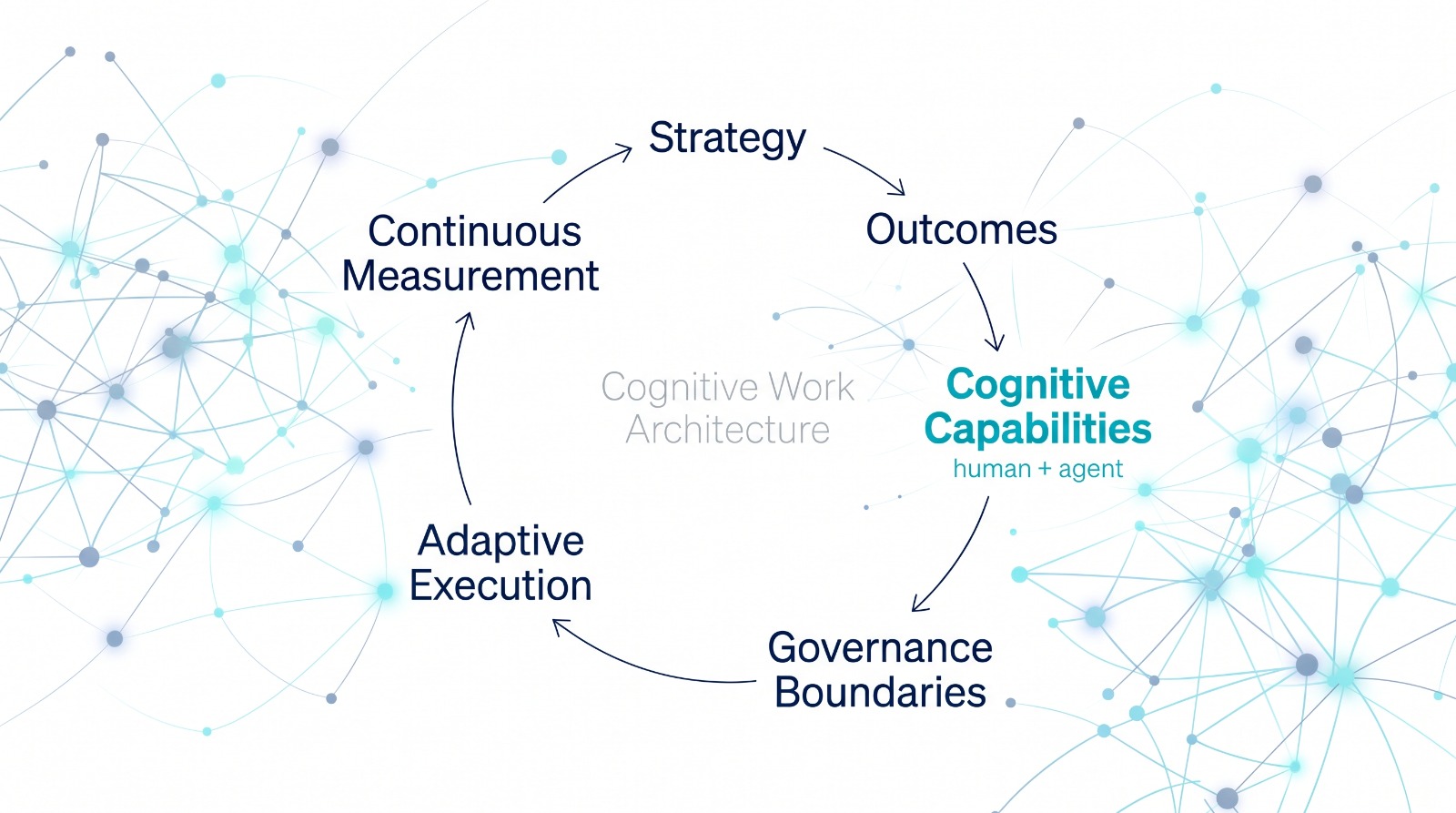
Cognitive Work Architecture:
Strategy → Outcomes → Cognitive Capabilities (human + agent) → Governance Boundaries → Adaptive Execution → Continuous Measurement
The difference is not cosmetic. In a traditional TOM, if you want to change how work gets done, you reorganize. In the CWA, you reconfigure. The boundaries stay fixed. The execution within those boundaries is fluid.
The Control Inversion
This is the concept that makes most executives uncomfortable — until they realize they already live with a version of it.
In the CWA, leadership controls five things absolutely:
- Strategic direction: where the organization is headed and why.
- Outcome targets: the KPIs, financial metrics, and performance thresholds that define success.
- Cost envelopes: the economic boundaries within which execution must operate.
- Risk and compliance boundaries: the non-negotiable constraints from regulation, ethics, and enterprise policy.
- Escalation architecture: the conditions under which autonomous execution must stop and a human must decide.
Everything else — the how, the who (human or agent), the what tools, the what sequence — is flexible within those boundaries.
This is not chaos. This is the same principle that makes product & platform models work, extended to its logical conclusion. A well-run product team already has autonomy over how they deliver within a defined outcome and budget. The CWA extends that autonomy to include what kind of intelligence does the work — human judgment, agent execution, or a continuously adapting blend of both.
In an agentic enterprise operating model, humans define goals, constraints, and escalation thresholds. AI agents execute within those boundaries. Governance is embedded directly into workflows through policy agents, critic agents, and monitoring systems that log decisions in real time.
The executives I talk to who resist this idea usually come around when I ask one question: “Do you currently approve every line of code your engineering team writes, or do you set standards, review outcomes, and intervene on exceptions?” They all do the latter. The CWA applies the same principle to the entire operating model — not just engineering.
Day in real Life: Supply Chain Exception Handling
Theory is useful. Scenarios are convincing. Here’s the same workflow — a supply chain exception triggered by a critical component disruption — running under three operating models.
Scenario: A Tier 1 automotive supplier receives a force majeure notification from its Tier 2 casting partner — a furnace failure at the foundry will delay delivery of a critical housing component by six weeks, affecting three production lines and shipment commitments to two OEM customers.
Under a Lean TOM:
- Supplier quality engineer receives the force majeure notice via email from the Tier 2 account manager. Logs the disruption in the ERP as a supplier non-conformance.
- SQE escalates to the commodity manager. Commodity manager confirms the component is single-sourced — no qualified alternate in the approved supplier panel.
- Commodity manager escalates to the supply chain director. Director convenes a cross-functional war room — procurement, production planning, manufacturing engineering, logistics, customer program management. Meeting scheduled for Thursday (it’s Monday).
- Thursday meeting: 90 minutes. Data is gathered manually from three systems. Manufacturing engineering needs two days to assess whether an alternate casting from the conditional supplier panel can meet dimensional tolerances and material specifications. Production planning presents conflicting inventory burn-rate numbers because they pulled reports at different times from different plant systems.
- Decision: qualify the alternate source on an emergency basis. Director approves. Quality engineering initiates a deviation request with both OEM customers — which requires customer quality approval before any parts can ship.
- OEM Customer A responds in 4 business days. OEM Customer B requires a full PPAP waiver review — 8 business days.
- Alternate supplier first-article inspection: 5 additional days. Expedited freight arranged after the fact at 3x standard cost.
- Customer notification happens on Day 16. OEM Customer B triggers a controlled shipping protocol and charges back premium freight. OEM Customer A issues a formal supplier performance downgrade.
Elapsed time to resolution: 18-22 business days.Cost of delay: premium freight, customer chargebacks, supplier scorecard damage, and a deviation that lives in the quality system for the next audit cycle.
Under a Product & Platform TOM:
- Supply chain product team owns the end-to-end component availability workflow. The force majeure triggers an automatic alert from the supplier integration platform — the SQE, commodity manager, and program managers are notified simultaneously, not sequentially.
- Product owner triages within 4 hours. Cross-functional team (procurement, quality, manufacturing engineering, planning — embedded in the product team) pulls real-time inventory data from the shared data platform. Single source of truth — no conflicting burn-rate numbers.
- Manufacturing engineering queries the engineering data platform: the conditional supplier’s casting has a prior material equivalency study on file from a sourcing review 18 months ago. The dimensional analysis is 80% complete — estimated 2 days to close the gap, not 5.
- Product owner has authority to initiate a deviation request within a pre-approved disruption protocol. Requests go to both OEM customers on Day 1.
- Alternate supplier RFQ goes out same day via the procurement platform. Automated supplier matching confirms the conditional supplier has available capacity.
- Customer program team (separate product team) coordinates OEM responses. OEM Customer A approves on Day 3. OEM Customer B still requires PPAP waiver — but the request was filed on Day 1 instead of Day 10, so the clock started earlier.
Elapsed time to resolution: 8-12 business days.Improvement: Real. Meaningful. But still human-speed at every decision point. And the OEM waiver process — which the Tier 1 does not control — remains the critical path.
Under a Cognitive Work Architecture:
- Supply chain monitoring agent detects the disruption signal before the formal force majeure notice arrives — anomalous logistics patterns from the Tier 2 (shipment frequency drop, carrier booking cancellations) triggered a risk flag 72 hours earlier. The program team was already on alert.
- When the formal notice lands, the agent immediately executes four parallel workstreams:
- Qualification agent queries the engineering knowledge graph: pulls the prior material equivalency study, identifies the three remaining dimensional gaps, cross-references the alternate casting’s material certification against both OEM customers’ specific material specifications (which differ), and generates a gap analysis with a recommended test plan.
- Impact simulation agent runs a production impact model across all three affected lines — calculating inventory burn-down by SKU at hourly granularity, identifying the exact shift where each line will starve, and modeling the downstream effect on OEM delivery windows against contractual lead-time commitments.
- Commercial agent queries the alternate supplier’s capacity agent (ecosystem interoperability — the supplier’s system exposes real-time available-to-promise data via a secure context exchange protocol). Confirms capacity. Generates a purchase commitment within pre-approved commercial parameters.
- Customer communication agent drafts deviation requests for both OEM customers — each tailored to that OEM’s specific quality system requirements, submission format, and preferred contact. Attaches the gap analysis, the proposed test plan, the production impact timeline, and a mitigation schedule.
- Exception governance agent evaluates the aggregate exposure: combined financial impact crosses the $2M authority threshold → escalation triggers. Supply chain director receives a structured decision package: problem confirmed, impact quantified across all affected programs, alternate source identified with capacity confirmed, qualification gap analysis with estimated closure timeline, two OEM deviation requests drafted and ready to submit, and three ranked resolution options with cost/time/risk trade-offs.
- Director reviews. Modifies Option 2 — adds a requirement for enhanced incoming inspection on the first three lots from the alternate source (a judgment call based on relationship history with that supplier that no agent would have). Approves. Total decision time: 45 minutes.
- Deviation requests submit to both OEMs within hours of the disruption — not days. OEM Customer A’s quality system receives a machine-readable submission and routes it for auto-approval against their pre-qualified deviation criteria. OEM Customer B still requires human review — but the submission arrived on Day 1 with complete documentation, not on Day 10 with gaps that trigger a request-for-information loop.
- Monitoring agent tracks first-article inspection results, adjusts production scheduling in real-time as qualification milestones are hit, and flags any secondary risks — including monitoring the original Tier 2’s furnace repair timeline in case early recovery changes the optimal path.
Elapsed time to resolution: 2-4 business days (bounded by OEM Customer B’s human review process — the one step the Tier 1’s operating model cannot compress). Director’s involvement: 45 minutes of high-value judgment — the incoming inspection call, the supplier relationship nuance — instead of 3 weeks of coordination overhead. What changed: The bottleneck shifted from internal coordination (which the CWA eliminated) to external customer approval processes (which the CWA compressed by submitting complete, accurate documentation on Day 1 instead of Day 10). The Tier 1 did everything within its control at machine speed. The remaining constraint is the ecosystem — which is exactly why ecosystem interoperability is an operating model concern, not a technology integration afterthought.
Why This Isn’t Just “Adding AI to the Org Chart”
The scenario above might tempt some readers to think: “So we just add AI agents to our existing operating model and get faster.” That is precisely the cloud migration mistake replaying itself.
Bolting agents onto a lean TOM gives you agents waiting for approval chains that were designed for human-speed execution. Bolting agents onto a product & platform TOM gives you agents trapped inside team boundaries that were designed for human coordination. In both cases, the operating model becomes the constraint, not the enabler.
When AI is layered onto legacy enterprise operating models, rather than reshaping how decisions, workflows, and accountability work, scale becomes fragile. Most failures trace back to something more structural: the AI operating model itself.
The CWA doesn’t add intelligence to the existing model. It redesigns the model around the assumption that intelligence is distributed, adaptive, and continuous — and then places humans at the points of highest leverage: setting direction, making judgment calls that require ethical reasoning or relationship context, handling genuine exceptions, and governing the boundaries within which the cognitive fabric operates.
When coordination becomes cheap, hierarchy becomes an expensive liability. Humans stop being information routers and become outcome owners, while AI serves as the execution infrastructure.
Governance: Tighter, Not Looser — Because It’s Enforced, Not Reviewed
The most common objection I hear from risk officers, compliance leaders, and board members is: “This sounds like you’re removing human oversight.”
The opposite is true. But let me go further than reassurance — let me explain the architectural difference.
In a traditional TOM, governance is aspirational. You write a policy. You train people on it. You review compliance periodically — monthly architecture boards, quarterly risk committees, annual audits. Between those checkpoints, execution is effectively ungoverned. You trust that people are following the process because the consequences of not following it are real. But trust is not a control. It’s a hope with organizational consequences.
In the best product & platform models, governance improves — sprint reviews, release gates, platform permissions. But it’s still observational. You watch what happened and react. The feedback loop is tighter, but it’s still a loop — there is a gap between action and oversight.
The Cognitive Work Architecture introduces a third model: enforceable governance. Not governance that watches. Not governance that reviews. Governance that is built into the execution substrate itself — automated policy validation running natively at the data layer and the model endpoint, enforced before an action is taken, not after it’s discovered.
This means:
- Policy agents evaluate every agent action against compliance rules, contractual constraints, and ethical boundaries at runtime — not at the next committee meeting, but in the moment of execution.
- Threshold enforcement is architectural, not procedural. When the supply chain agent in our scenario hit the $2M exposure boundary, it didn’t “flag it for review.” It stopped. The boundary is a locked door, not a warning sign.
- Audit trails are not retrospectively assembled by a compliance team pulling logs from six systems. They are continuously generated as a native byproduct of execution. Every decision is traceable to the authority that permitted it, the data that informed it, and the governance rule that constrained it.
- Critic agents assess output quality, bias risk, and confidence levels before any output reaches a customer, a system of record, or a downstream agent. The review happens at machine speed, with human escalation triggered by exception — not by calendar.
Governance can no longer remain a static review function. It must become part of runtime execution.
The CWA doesn’t ask the board to trust the AI. It doesn’t even ask the board to trust the process. It gives the board enforceable constraints — policy as code, boundaries as architecture, escalation as physics. The question for risk officers is no longer “do I trust the agent?” It’s: “Do I trust a quarterly review cycle more than I trust continuous enforcement with real-time escalation and a complete decision audit trail?”
When framed honestly, the answer has never been ambiguous.
Beyond the Enterprise Boundary: Where Every Other Model Stops
There is a dimension of the operating model challenge that virtually no one in the current conversation is addressing — and it may be the most consequential.
Every operating model discussed in this article — lean, agile, product & platform, and even most published agentic frameworks — treats the enterprise as a closed system. The operating model governs what happens inside your walls. Your teams, your agents, your data, your governance.
But modern enterprises do not operate inside walls. They operate inside ecosystems. Your supply chain spans dozens of partners across multiple geographies. Your customers’ procurement systems are becoming autonomous. Your regulators are moving toward real-time compliance feeds. Your channel partners, logistics providers, and financial intermediaries are all on their own AI adoption curves — building their own agents, their own cognitive capabilities, their own autonomous workflows.
The question that no one is designing for: What happens when your agents need to securely trade context with your partners’ agents?
Go back to the supply chain scenario. The CWA-driven response identified alternative suppliers, ran impact simulations, and generated customer communications — all within the enterprise boundary. But the actual resolution required the organization to interact with external entities:
- Querying a supplier’s capacity agent for real-time available-to-promise data (not last week’s portal update).
- Submitting a machine-readable deviation request to an OEM customer’s quality system for auto-routing against pre-qualified criteria.
- Validating an alternate component source against a regulatory body’s current approved-materials database.
- Negotiating commercial terms with a supplier’s pricing agent within pre-approved parameters.
In a traditional operating model, every one of these interactions requires a human intermediary — an email, a phone call, a portal login, a meeting. The human is the interoperability layer. That works when transactions are measured in days and weeks. It breaks completely when your internal operating tempo compresses to hours and your external interfaces remain stuck at human speed.
The Cognitive Work Architecture addresses this by designing ecosystem interoperability as a first-class operating model concern — not a technology integration problem to be solved later, but a structural capability that the operating model must specify:
- Trust boundaries — which external agents are authorized to interact with which internal agents, under what conditions, with what data visibility? This is not a firewall rule. It is an operating model decision about organizational sovereignty.
- Context exchange protocols — how does your supply chain agent share a demand signal with a supplier’s capacity agent without exposing proprietary production data? What is the minimum viable context for a cross-boundary interaction to succeed?
- Governance reciprocity — when your agent and a partner’s agent negotiate a commitment, who is accountable? How is the decision reconstructed across two different governance architectures? Where does the audit trail live?
- Asymmetric maturity — not every partner will have an agentic operating model. The CWA must be able to interact with a partner’s legacy systems (EDI, portals, email) with the same fluency it uses for agent-to-agent coordination. The cognitive fabric adapts to the external interface — it does not require the external world to adapt to it.
This is the frontier. And it is arriving faster than most executives realize. When your largest customer’s procurement system starts sending autonomous RFQs — not next decade, but in the next 18-24 months — your operating model will either be designed to receive, evaluate, and respond to them at machine speed, or you will be the bottleneck in your own value chain.
The organizations that design for ecosystem interoperability now will become the nodes that autonomous commerce flows through. The ones that aren’t will discover that their beautifully optimized internal operating model stops at the walls of the enterprise — exactly where the most consequential interactions begin.
The Choice
There is a sentence that should hang above every boardroom projector: “An organizational chart is meant to give you a snapshot of how things are organized so far — not how things will happen in the future.”
Every operating model in history has been a bet on the capabilities available at the time. Lean bet on disciplined humans and standardized processes. Agile bet on small teams and iterative feedback. Product & platform bet on persistent ownership and shared technology infrastructure. Each bet paid off — until the capability landscape shifted and the operating model designed for the previous era became the ceiling, not the floor.
The technology that an operating model has to design around has changed more in the last fifteen years than in the prior fifty. Each wave reshaped the very thing the operating model was built to govern. The discipline was not failing because the answers were unknown; it was failing because the question kept changing faster than mainstream practice could keep up with.
The capability landscape has shifted again. Intelligence is no longer exclusively human. Execution is no longer exclusively sequential. Coordination is no longer expensive. Governance no longer has to choose between thoroughness and speed. And the enterprise boundary is no longer the boundary of the operating model.
The Cognitive Work Architecture is built for this landscape — not by abandoning what came before, but by removing the structural ceilings that every previous model shares: the assumption that humans are the only workers, that governance must trade speed for rigor, and that the operating model stops at the enterprise wall.
The organizations that design for this reality will compress decision cycles from weeks to hours, enforce governance at the speed of execution rather than the speed of committees, and extend their operating model into the ecosystem interactions where the most consequential value is created and lost.
The organizations that don’t will do what the cloud laggards did: spend more, move slower, and explain to the board why the investment isn’t producing returns.
You are either designing your operating model for intelligence-era execution, or you are optimizing a photograph of an organization that no longer exists.
There is no third option.
Alex Cuciurean | Cognitive Work Architecture Series — Part III
P.S. — Guess who helped me write this one too. 🔴 Sara. I came with the rough idea — the thesis, the provocation, the instinct. Sara structured the writing, found the research, and assembled the first draft. I stress-tested it — flagged a straw man argument, questioned whether a Tier 1 automotive supplier would actually source raw semiconductors, pushed back until the narrative held up under pressure. Sara iterated, putting the ideas into well-structured, stochastically machine-learned English. Four rounds. The human brought the thinking. The machine brought the structure, the speed, and the research. Neither of us could have written this article alone. That’s the Cognitive Work Architecture in practice.